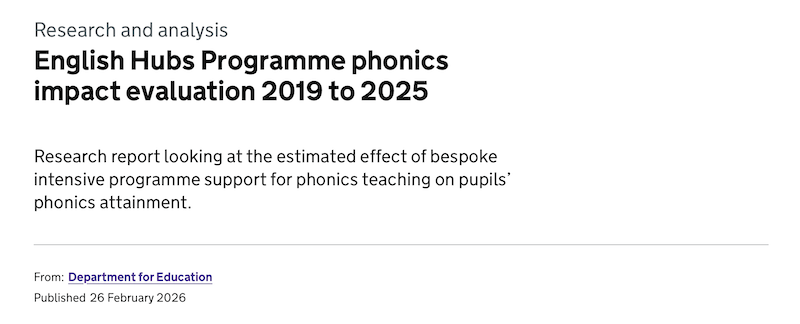
The Department for Education published its long-awaited impact evaluation of the English Hubs Programme (EHP) on the 26th February 2026, covering the period from the programme's launch in 2018/19 through to June 2025. Coincidentally, it arrives at almost exactly the same time as a blogpost from the well-respected literacy researcher Timothy Shanahan. The two documents raise interesting questions about what we are measuring, and what we might be missing.
What the English Hubs evaluation found
The English Hubs Programme (EHP) places Literacy Specialists into struggling primary schools — those with low phonics results and high proportions of disadvantaged pupils — to provide intensive, bespoke coaching support over two to three years. Since 2018, 34 English Hubs have worked with nearly 3,000 partner schools across England.
The headline finding is that intensive EHP support increases the proportion of Year 1 pupils passing the Phonics Screening Check (PSC) by 3 to 5 percentage points by the end of the full support period. For a typical two-form-entry school, that's roughly two or three additional children passing who otherwise would not have done.
The first wave of schools (supported September 2019 to July 2022) showed a 2–3 percentage point improvement sustained across the three years after support ended — equivalent to around 1,500 to 2,250 additional children passing the check between 2022 and 2025. The fifth cohort (beginning support from autumn 2023) showed a 3–4 percentage point improvement over their first two years — around 1,500 to 2,000 additional passes. Impact grew with each year of support and was partially, though not fully, sustained after the programme ended.
The effect sizes (0.11–0.15) are comparable to what meta-analyses find for teacher coaching programmes, and broadly equivalent to the reading advantage a child gains from having a teacher with 6–12 years of experience rather than a newly qualified one — notable given the EHP operates at a scale of nearly 3,000 schools, far larger than the trials typically underpinning such comparisons.
Phonics as a Part of the Story
Published a week or two before the DfE report, the blogpost 'Are We Teaching Too Much Phonics?' by Professor Timothy Shanahan — former director of reading for Chicago Public Schools and one of the authors of the landmark US National Reading Panel report — offers a timely counterpoint. Writing in response to claims by cognitive scientist Mark Seidenberg that schools are now teaching too much phonics, Shanahan argues that the real problem is not the amount of phonics but the lack of specificity about how literacy time is used overall.
"Admonitions to teach phonics are almost certain to get somebody to overdo it, just as cautions against too much phonics will likely encourage some to pull back too much."
His solution is not less phonics but greater precision: he advocates dividing total literacy instruction time equally across four components — decoding, fluency, comprehension, and writing — with phonics occupying around 30 minutes per day, consistent with the successful implementations in the research base.
Shanahan is clear that phonics is necessary but not sufficient. Drawing on Scarborough's influential reading rope model and the Simple View of Reading (Gough & Tunmer, 1986), he emphasises that decoding matters enormously — but so do language comprehension, fluency and writing, and problems in any of these can undermine a child's reading success regardless of how well they can decode. Crucially, research by Connor et al. (2011) found that children who had already mastered decoding gained more from independent language-oriented activities than from sitting through further phonics lessons — suggesting that blanket phonics instruction for all children, regardless of starting point, is not the most effective use of time.
This resonates with a limitation the DfE report itself acknowledges: the PSC measures decoding only, and does not capture improvements in comprehension, writing, or reading enjoyment — all of which the accompanying process evaluation suggests are real benefits of the EHP, but which remain unquantified.
What did it cost?
A
That figure demands context. The £100m also funded non-intensive support — CPD events, audits and resource grants — for over 10,000 schools; separating intensive from non-intensive spend would likely reduce the cost per outcome considerably. And the PSC pass rate understates the true benefit: children who pass in Year 1 avoid reassessment in Year 2, teachers trained through the programme carry skills to new schools, and reading leads develop lasting leadership capability.
"If the poor schools teach only as much reading as the more advantaged ones, then kids in the poor schools can never catch up."
As Shanahan argues compellingly, the alternative to early intervention is not free. The long-run cost of children who don't become fluent readers — in SEN support, intervention programmes, and lost life chances — is rarely factored into these comparisons, but it should be.
What comes after phonics?
Having invested heavily in improving phonics teaching, are schools now adequately supported across the other components of literacy? The answer, encouragingly, is that the English Hubs are already moving in this direction.
From autumn 2025, the English Hubs expanded their remit to include reading fluency — precisely the bridge between decoding and comprehension that Shanahan identifies as a critical next step. HFL Education (Herts for Learning) was awarded a £76,000 DfE contract in April 2025 to develop a national, evidence-based fluency CPD programme for Years 3–6, running through to March 2026. Designed as a six-session train-the-trainer scheme for English Hub leaders, it focuses on the three pillars of fluency — accuracy, automaticity and prosody — and draws on the work of world-renowned fluency researcher Professor Tim Rasinski. HFL's own Reading Fluency Project, currently subject to an EEF trial, has previously shown fluency score improvements of an average of 3.5 points.
This is a meaningful signal. The English Hubs infrastructure — built painstakingly around phonics over seven years — is beginning to be deployed across the wider literacy curriculum, in a way that aligns well with the evidence base Shanahan describes. Comprehension and writing — the other two components in Shanahan's framework — have yet to receive equivalent national infrastructure. That remains the next frontier.
The bottom line
The DfE report is well-designed and its conclusions are credible. The EHP has demonstrably moved the dial on early decoding for some of England's most disadvantaged children, and maintained that impact at scale — no small feat. Read alongside Shanahan's challenge to the field, and the emerging fluency work, it points to an education system beginning to think more holistically about what it takes to create genuinely capable readers — not just children who can pass a screening check.
A complete cost-effectiveness analysis — separating intensive from non-intensive spend, accounting for downstream literacy benefits, and benchmarking against alternative uses of public money — has not been done publicly. Perhaps it should be.
Sources
Shanahan, T. (2026, February 14). Are we teaching too much phonics? Shanahan on Literacy.
HFL Education (2025, June 5). Roll out of HFL Reading Fluency Programme from DfE English Hubs.
Schools Week. Reading at English Hub schools holds up post-pandemic. (Programme spend figure.)